
#85 Brain Death w/ Dr Sean Marinelli
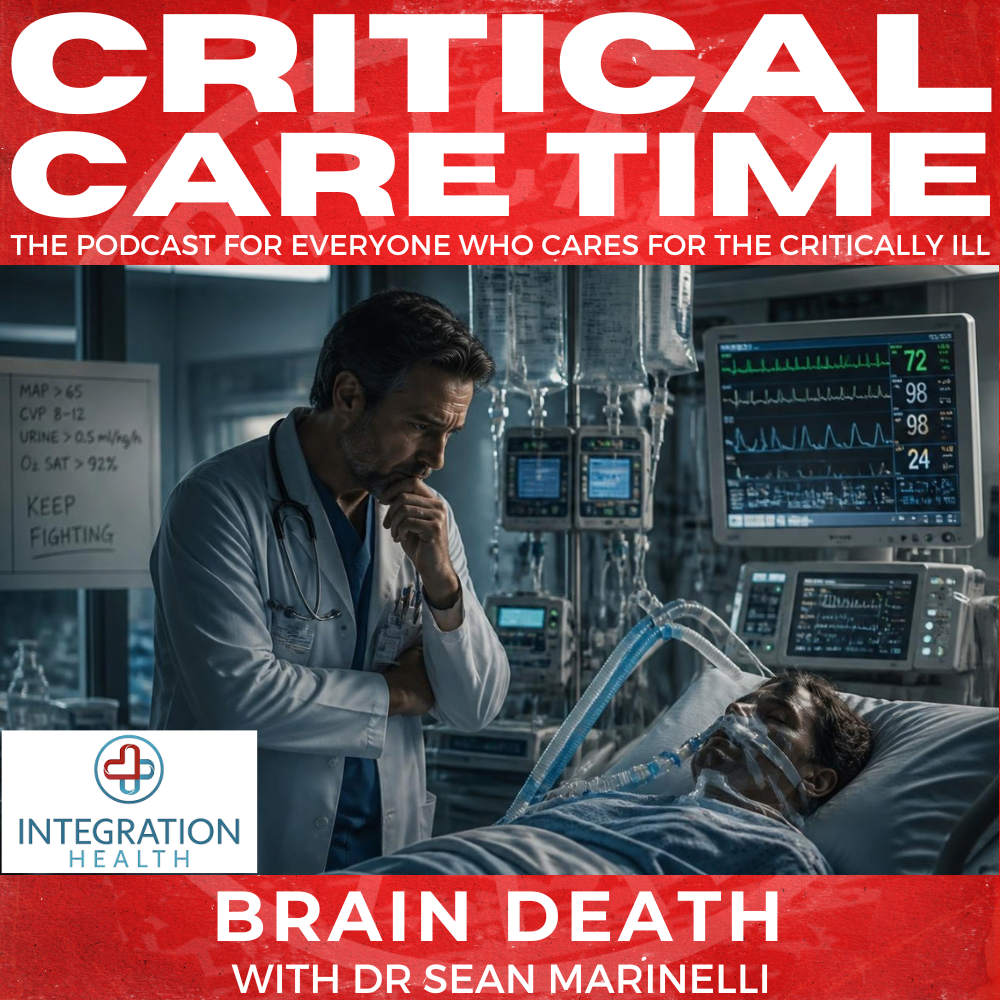
In this episode of Critical Care Time, neurointensivist Dr. Sean Marinelli joins Nick & Cyrus to tackle brain death/death by neurologic criteria. We break down the prerequisites, neurologic exam, apnea testing, ancillary studies, and the challenging situations where things get complicated—including confounders, ECMO, and families struggling to understand how someone with a beating heart can have died.
This is essential knowledge for anyone caring for critically ill patients. Listen or watch now, and if you enjoy the episode, subscribe, leave us a five star review, and drop a comment with your thoughts!
Our Guest

Dr. Sean Marinelli, MD
University of Washington, Assistant Professor of Neurology
Brain death—or death by neurologic criteria (BD/DNC)—is one of the most consequential diagnoses made in critical care. It is also frequently misunderstood by clinicians, patients, and families.
In this episode, neurologist and neurointensivist Dr. Sean Marinelli joins us to walk through what brain death actually means, how the diagnosis is made, the physiology behind the examination and apnea test, when ancillary testing is appropriate, and how the process changes in challenging situations such as ECMO. We also discuss the history, legal framework, and difficult conversations that occur when families struggle to accept the diagnosis.
What is brain death?
Brain death/death by neurologic criteria is the permanent loss of function of the brain as a whole, including the brainstem, manifested clinically by:
* Coma
* Absence of brainstem reflexes
* Apnea despite an adequate physiologic stimulus
The key point:
Brain death is death.
It is not simply severe neurologic injury or a prediction that neurologic recovery is unlikely. In the United States, determination of death by neurologic criteria is legally a determination of death.
Brain death must also be distinguished from other disorders of consciousness.
Coma: neither awake nor aware.
Unresponsive wakefulness syndrome (formerly vegetative state): wakefulness without convincing evidence of awareness.
Minimally conscious state: reproducible but limited evidence of awareness.
Patients in these states retain some brain function. Brain death requires a much more specific and rigorous set of findings.
Why did we need a definition of brain death?
Historically, death was straightforward: circulation stopped, respiration stopped, and shortly thereafter brain function ceased.
Modern medicine separated these events.
Defibrillation made cardiac arrest potentially reversible, while positive-pressure ventilation allowed circulation and oxygenation to continue despite catastrophic neurologic injury.
In 1959, Mollaret and Goulon described Le Coma Dépassé ("beyond coma"). The 1968 Harvard Ad Hoc Committee subsequently proposed clinical criteria for what became known as brain death.
The Uniform Determination of Death Act (UDDA) later established the legal framework in the United States for determining death using either circulatory or neurologic criteria.
Determining brain death
The modern diagnosis of BD/DNC is fundamentally clinical.
The 2023 AAN/AAP/CNS/SCCM consensus guideline provides the current U.S. framework and emphasizes a standardized, conservative process designed to prevent false-positive determinations.
Think of the evaluation in three parts:
Prerequisites → Neurologic examination → Apnea testing
Ancillary testing is reserved for situations in which the clinical examination or apnea test cannot be safely or adequately completed or interpreted.
Step 1: Prerequisites
Before beginning a brain-death examination, there must be a known catastrophic brain injury capable of causing permanent loss of brain function.
Neuroimaging should be consistent with the mechanism and severity of the injury.
Important physiologic prerequisites include:
* Core temperature >36°C
* Adequate blood pressure and perfusion
* Adequate oxygenation
* Correction of severe metabolic abnormalities
For adults, current guidelines specify both SBP ≥100 mmHg and MAP ≥75 mmHg, unless the patient's known chronic baseline requires a different target.
Confounders must also be excluded.
These include:
* Sedatives and other CNS-depressing medications
* Intoxicants
* Neuromuscular blockade
* Severe metabolic or endocrine abnormalities
* Hypothermia
* Conditions preventing reliable examination
Drug clearance deserves particular attention in patients with renal or hepatic dysfunction, prolonged infusions, or hypothermia.
If the core temperature has been ≤35.5°C, current guidelines recommend waiting at least 24 hours after rewarming to ≥36°C before evaluating for BD/DNC.
The principle is deliberately conservative:
If a confounder could plausibly explain the examination, don't diagnose brain death yet.
Step 2: The neurologic examination
The examination establishes:
Coma + brainstem areflexia
The patient must have no evidence of consciousness or brain-mediated motor response despite maximal stimulation.
Brainstem testing proceeds anatomically through the brainstem and includes:
* Pupillary light reflex
* Corneal reflex
* Oculocephalic reflex when appropriate
* Oculovestibular reflex
* Facial motor response to noxious stimulation
* Gag reflex
* Cough reflex
Cold caloric testing evaluates the oculovestibular reflex. In a patient with intact brainstem function, vestibular stimulation produces eye movement. In BD/DNC, the eyes remain fixed.
Cervical spine or skull-base injuries may prevent some portions of the examination from being performed safely.
Spinal reflexes can still occur
Not every movement originates from the brain.
Patients who meet criteria for brain death may retain spinally mediated reflexes, including triple flexion and other complex-appearing movements.
These movements do not necessarily indicate preserved brain function.
The important question is whether the movement is brain-mediated or spinally mediated. If the distinction is uncertain and prevents confident interpretation of the examination, ancillary testing may be necessary.
Step 3: The apnea test
The apnea test asks a physiologic question:
Does severe hypercapnia and acidemia stimulate the medullary respiratory centers enough to produce spontaneous breathing?
The patient is preoxygenated and a baseline arterial blood gas is obtained. Ventilatory support is then removed while oxygenation is maintained, and the chest and abdomen are directly observed for spontaneous respiratory effort.
Current U.S. criteria require:
PaCO₂ ≥60 mmHg AND ≥20 mmHg above baseline
and
arterial pH <7.30
with no spontaneous respirations.
This matters because both hypercapnia and acidemia provide potent stimulation to medullary respiratory centers.
The test should be aborted for significant instability, including severe hypoxemia, hypotension, or unstable arrhythmia.
Ancillary testing
Brain death is primarily a clinical diagnosis.
Ancillary testing should not simply replace portions of an examination that can otherwise be completed. It is used when some component of the neurologic examination or apnea test cannot be safely completed or reliably interpreted.
Acceptable ancillary tests under the current U.S. guideline include:
* Four-vessel catheter angiography
* Radionuclide cerebral blood-flow/perfusion imaging
* Transcranial Doppler ultrasonography in adults
These tests evaluate whether there is cerebral blood flow.
Importantly, several tests commonly associated with brain-death evaluation are not currently accepted ancillary tests under the 2023 U.S. guideline:
* EEG
* Somatosensory or auditory evoked potentials
* CT angiography
* MR angiography
* MRI
EEG, for example, primarily assesses cortical electrical activity and cannot adequately establish loss of function of the brain as a whole, including the brainstem.
Brain death on ECMO
ECMO creates an especially interesting physiologic problem.
The oxygenator can remove CO₂ independently of the patient's lungs. Consequently, simply disconnecting the ventilator may not generate the hypercapnia and acidemia required to test medullary respiratory drive.
Apnea testing can still be performed on ECMO, but sweep gas must be reduced carefully while oxygenation and hemodynamics are maintained.
For VA-ECMO, blood gases require special attention because native cardiac output and retrograde ECMO flow may create differential gas tensions across the arterial circulation.
Current guidelines recommend sampling both a distal patient arterial line and the ECMO circuit post-oxygenator during VA-ECMO apnea testing to establish that the cerebral circulation has received an adequate hypercapnic and acidemic stimulus.
If apnea testing cannot be performed safely, ancillary cerebral blood-flow testing may be appropriate.
Case 1: Post-cardiac arrest
A patient remains comatose after cardiac arrest with:
* Fixed pupils
* Absent corneal reflexes
* Absent cough and gag
* No brain-mediated motor response
* Imaging consistent with catastrophic cerebral injury
* No physiologic or pharmacologic confounders
Triple flexion of the legs does not invalidate the examination if clearly spinal in origin.
After an adequate apnea test produces the required hypercapnia and acidemia without respiratory effort, criteria for BD/DNC are satisfied without requiring ancillary testing.
Case 2: Confounders after cardiac arrest
Consider instead a post-arrest patient who recently received propofol, fentanyl, and neuromuscular blockade, underwent therapeutic hypothermia, has severe renal failure, remains mildly hypothermic, and becomes hypotensive during apnea testing.
This patient is not ready for BD/DNC determination.
Rewarm the patient, establish adequate perfusion, exclude residual neuromuscular blockade, and allow adequate time for CNS-depressing medications to clear.
Brain death determination is rigorous precisely because there is rarely a need to rush it.
If the examination ultimately becomes reliable but the patient cannot physiologically tolerate apnea testing, ancillary testing may then become appropriate.
Case 3: VA-ECMO
In VA-ECMO, the central challenge is demonstrating an adequate hypercapnic stimulus despite extracorporeal CO₂ removal.
Preoxygenate through both the ventilator and circuit, carefully reduce sweep, and follow serial arterial blood gases.
Because the ECMO/native circulation mixing point may be uncertain, sampling both the patient and post-oxygenator circulation helps ensure that the brain has actually experienced the required hypercapnia and acidemia.
If this cannot be accomplished safely, cerebral blood-flow testing provides an alternative route to determination.
Communicating brain death
Communication may be as important as the examination itself.
A ventilated patient who has died by neurologic criteria can remain warm. The heart may continue beating. The chest continues moving because the ventilator is delivering breaths.
To families, this may look very different from their mental model of death.
Clear language matters.
Rather than describing brain death as a "poor prognosis" or saying that a patient is "essentially dead," explain that brain death is a medical determination of death.
Current guidelines recommend clear, concise, supportive communication and reasonable attempts to inform families before the BD/DNC evaluation begins. Families may also be permitted to observe the examination or apnea test.
Religious and cultural objections require particular sensitivity, and laws differ by jurisdiction. New Jersey, for example, has historically provided a religious accommodation affecting determination of death by neurologic criteria, while other states have requirements regarding reasonable accommodation.
Ethics, spiritual care, nursing leadership, hospital administration, and legal counsel can all be valuable when disagreement persists.
Importantly, determination of death and organ donation are completely separate processes.
Take-home points
1. Brain death is death—not a prognosis.
2. BD/DNC requires a known catastrophic and permanent brain injury.
3. Exclude confounders first: hypothermia, hypotension, drugs, paralysis, and severe metabolic abnormalities.
4. The clinical diagnosis requires coma, brainstem areflexia, and apnea.
5. Spinal reflexes can persist after brain death.
6. Apnea testing requires an adequate hypercapnic and acidemic stimulus: PaCO₂ ≥60 and ≥20 above baseline, with pH <7.30.
7. Ancillary testing is used when the clinical examination or apnea test cannot be completed or interpreted, not simply because another test is available.
8. Current accepted U.S. ancillary studies focus on cerebral blood flow; EEG, CTA, and MRI are not accepted ancillary tests under the 2023 guideline.
9. Brain-death determination can be performed on ECMO, but apnea testing requires careful manipulation of sweep and appropriate blood-gas sampling.
10. The diagnosis is intentionally rigorous and conservative. Communication with families deserves the same care as the physiologic evaluation.
-
-
-
Greer DM, Kirschen MP, Lewis A, et al. Pediatric and Adult Brain Death/Death by Neurologic Criteria Consensus Guideline: Report of the AAN Guidelines Subcommittee, AAP, CNS, and SCCM. Neurology. 2023
Lewis A, Kirschen MP, Greer DM. The 2023 AAN/AAP/CNS/SCCM Pediatric and Adult Brain Death/Death by Neurologic Criteria Consensus Practice Guideline: A Comparison With the 2010 and 2011 Guidelines. Neurology Clinical Practice. 2023;13(6):e200189.
Greer DM, Shemie SD, Lewis A, et al. Determination of Brain Death/Death by Neurologic Criteria: The World Brain Death Project. JAMA. 2020;324(11):1078-1097. doi:10.1001/jama.2020.11586.
Uniform Determination of Death Act (UDDA). Uniform Law Commission.